-
Search Engine Optimization (SEO) is one of the most important strategies for improving a website’s visibility on search engines like Google. Businesses use SEO to increase organic traffic, improve rankings, and attract potential customers. However, not all SEO practices follow the same approach. Some methods focus on improving websites naturally and following search engine guidelines, while others try to manipulate search engine algorithms for quick results.
These two approaches are known as White Hat SEO and Black Hat SEO.
Understanding the difference between White Hat SEO and Black Hat SEO is important because choosing the wrong SEO strategy can damage your website’s ranking, reputation, and long-term growth.
What is White Hat SEO?
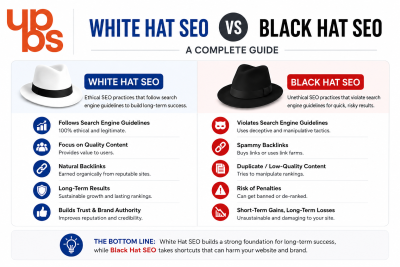
White Hat SEO refers to ethical SEO practices that follow search engine guidelines to improve website rankings naturally.
The main goal of White Hat SEO is to provide value to users by creating high-quality content, improving user experience, and building website authority over time.
White Hat SEO focuses on long-term growth rather than quick ranking results.
Examples of White Hat SEO Techniques
1. Creating High-Quality Content - Content is one of the biggest ranking factors in SEO. White Hat SEO focuses on creating useful, original, and informative content that solves users’ problems.
Examples:
Detailed blog articles
Helpful guides
Original research
User-focused content
Google rewards websites that provide valuable information to users.
2. Keyword Optimization - Using keywords naturally throughout website content helps search engines understand the topic of a page.
White Hat SEO includes:
Proper keyword research
Natural keyword placement
Optimized headings
Relevant content structure
It avoids keyword stuffing and unnatural repetition.
3. Building Quality Backlinks - White Hat SEO focuses on earning backlinks from trusted and relevant websites.
Examples:
Guest posting on relevant websites
Digital PR
Creating shareable content
Industry partnerships
Quality matters more than quantity.
4. Improving User Experience (UX) - Search engines consider user experience when ranking websites.
White Hat SEO improves:
Website speed
Mobile responsiveness
Easy navigation
Clear website structure
A better user experience helps visitors stay longer on the website.
What is Black Hat SEO?
Black Hat SEO refers to unethical SEO techniques that attempt to manipulate search engine algorithms to get faster rankings.These techniques usually violate search engine guidelines and may provide short-term benefits, but they can lead to penalties or even complete removal from search results.
Black Hat SEO focuses more on search engines than users.
Examples of Black Hat SEO Techniques
1. Keyword Stuffing - Keyword stuffing means using the same keyword excessively in content to manipulate rankings.
Example:
"Best SEO company is the best SEO company because the best SEO company provides the best SEO services."
This creates poor user experience and can harm rankings.
2. Buying Low-Quality Backlinks - Some websites purchase hundreds or thousands of backlinks from unrelated websites.
Problems:
Low-quality links
Spam websites
Risk of Google penalties
Search engines prefer natural and relevant backlinks.
3. Cloaking - Cloaking means showing different content to search engines and users.
Example:
A website shows SEO-related content to Google but shows something completely different to visitors.
This is considered a deceptive practice.
4. Duplicate Content - Copying content from other websites and publishing it as your own is a Black Hat SEO technique.
Duplicate content provides no unique value and may affect rankings.
5. Hidden Text and Hidden Links - Some websites hide keywords or links by making them invisible to users but visible to search engines.
Example:
Using white text on a white background to hide keywords.
White Hat SEO vs Black Hat SEO: Which One Should You Choose?
For long-term website growth, businesses should always choose White Hat SEO.
Although White Hat SEO takes more time, it creates:
Sustainable rankings
Better brand reputation
More organic traffic
Higher customer trust
Long-term business growth
Black Hat SEO may provide quick results, but search engines continuously update their algorithms to identify and remove manipulative practices.
Why Does Google Penalize Black Hat SEO?
Google’s main goal is to provide users with the most relevant and useful results.
Black Hat SEO practices create poor search experiences by:
Showing irrelevant pages
Reducing content quality
Manipulating rankings
Because of this, Google can take actions such as:
Ranking drops
Removing pages from search results
Manual penalties
How to Identify Whether an SEO Strategy is Safe?
Before using any SEO technique, ask:
Does this improve the user experience?
Is this technique following Google guidelines?
Would I still do this if search engines did not exist?
If the answer is yes, it is likely a White Hat SEO practice.
Real Business Example
White Hat SEO Approach
A new restaurant wants more customers.
They:
Create a Google Business Profile
Add location-based content
Upload food photos
Collect customer reviews
Publish helpful blogs
Build local backlinks
After some months, they start getting organic traffic and customers.
Black Hat SEO Approach
The same restaurant:
Buys fake reviews
Creates spam backlinks
Uses fake keywords
Copies competitor content
Initially, rankings may improve, but after Google detects manipulation, traffic can drop.
Why White Hat SEO is Better for Businesses?
White Hat SEO is the practice of improving search rankings using search-engine-approved methods focused on users, quality content, and long-term growth. For businesses, it creates sustainable results instead of short-term gains with higher risk.
1. Long-Term Rankings -White Hat SEO builds authority gradually through quality content, technical optimization, and genuine backlinks. Rankings tend to be more stable compared to manipulative tactics.
2. Lower Risk of Penalties - Search engines continuously update algorithms to detect spammy practices. White Hat methods reduce the chance of ranking drops, deindexing, or traffic loss.
3. Better User Experience - Good SEO today is closely tied to user satisfaction:
Fast-loading pages
Mobile-friendly design
Clear website structure
Helpful content
Easy navigation
These improvements also support conversions.
4. Builds Brand Trust - When users find useful content and a professional website experience, they are more likely to trust the business and return later.
5. Higher Quality Traffic - White Hat SEO focuses on matching search intent. That means attracting users who are actually interested in the product or service rather than generating artificial traffic.
6. Stronger Content Assets - Blogs, guides, landing pages, and optimized category pages continue generating value over time and can support other channels like social media and email marketing.
7. Supports Sustainable Growth - SEO becomes an investment rather than a recurring recovery effort. Businesses can scale content, backlinks, and technical improvements without worrying about penalties.
Common White Hat SEO Techniques
Keyword research based on user intent
High-quality original content
On-page optimization
Technical SEO improvements
Internal linking
Ethical link building
Schema markup
Mobile optimization
Improving Core Web Vitals
Conclusion
The main difference between White Hat SEO and Black Hat SEO is the approach used to improve search rankings. White Hat SEO focuses on creating value, improving user experience, and building long-term success. Black Hat SEO uses shortcuts that may create temporary results but can damage a website’s future.
For sustainable online growth, businesses should always invest in ethical SEO strategies and follow search engine best practices.